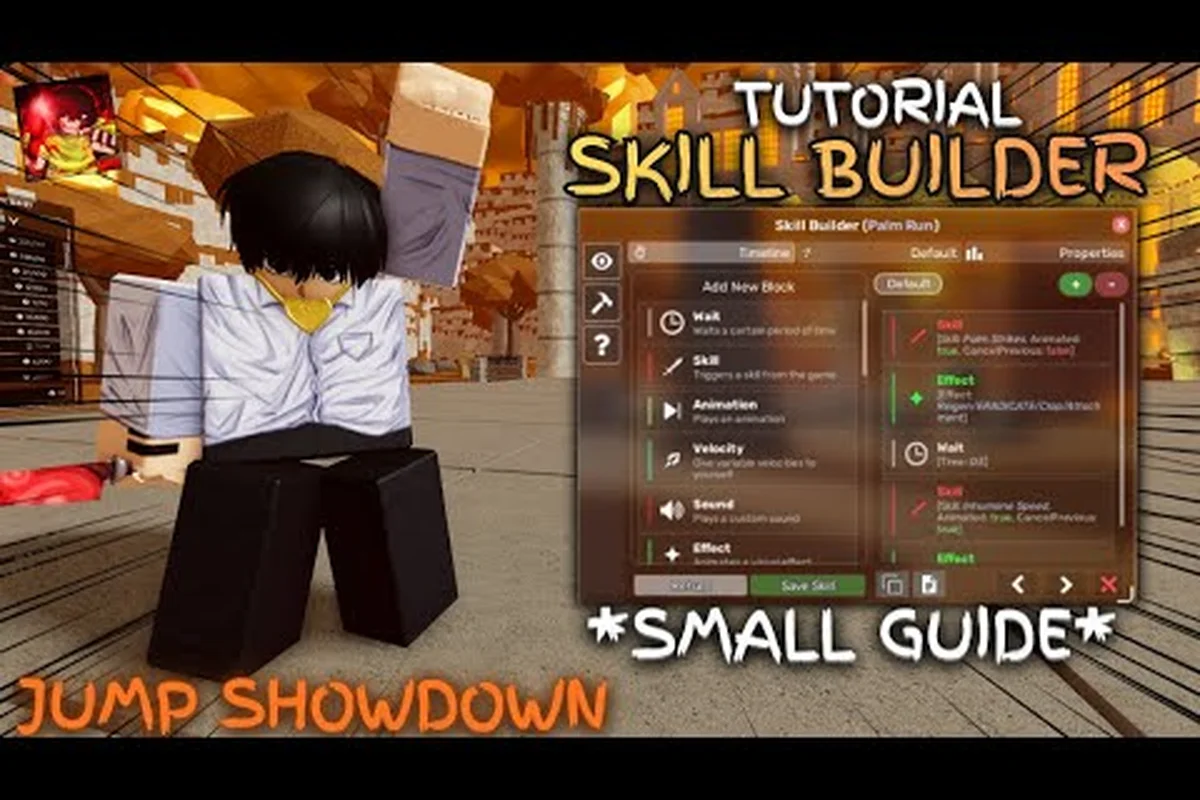
The Jump Showdown skill builder is a sandbox mode that lets fighters design their own custom moveset by stitching up to four signature abilities from across the entire character roster, layering an awakening transformation on top, and exporting the result as a shareable code. According to the official Jump Showdown page on Roblox, the system exists so players can prototype combos without grinding individual characters to max level, which makes it the fastest way to test wild synergies before committing in ranked play. For anyone looking to learn jump showdown how to use skill builder tools, this walkthrough covers the UI, the strongest community builds, and the best jump showdown custom moveset codes circulating in the workshop.
Understanding the Skill Builder Interface
Before diving into specific jump showdown best custom builds, it helps to know what the interface actually exposes. The skill builder UI is split into three logical zones—each of which controls a different layer of the loadout. The top zone handles move identity, letting you pick a base attack, projectile, or grab from a shared pool; the middle zone governs stat tuning (cooldown, reach, damage multipliers, and airborne arcs), which is where most jump showdown custom moveset codes diverge from the default roster; and the bottom zone manages cosmetic pairings, so swapping a move doesn't force a visual reset. Players who experiment with jump showdown skill builder codes quickly learn that reordering operations across these three layers—not just swapping one slot—is what produces the best custom builds the meta rewards.
The Four Custom Skill Slots
Every custom build in the jump showdown skill builder uses four discrete slots, numbered 1 through 4, mapped to the same input keys a player would press in a real match. You can fill those slots with any unlocked ability from any character on the roster, even if the source character is not in your active team. The slot mapping is what makes jump showdown custom moveset codes portable: a share code encodes exactly which ability sits in which slot, so a code copied from a friend reproduces the same configuration on your client.
| Slot | Typical Role | Example Ability | Source Character |
|---|---|---|---|
| Slot 1 | Poke / Neutral | Far Water | Aoi |
| Slot 2 | Reversal / Anti-Air | Frame-One Counter | Garou |
| Slot 3 | Launcher | Tectonic Control | Mob |
| Slot 4 | Unblockable Grab | Axe Slam | Kratos |
The table above is a common skeleton reported by community data on the Jump Showdown Discord — a projectile to control space, a reversal to stop jump-ins, a launcher to start combos, and an unblockable grab to close rounds.
Awakening Slot and Visual Layer
Above the four skill slots sits the awakening slot. Awakening is a transformation state that triggers automatically at a health threshold and swaps your basic attack chain for a powered-up version. The jump showdown skill builder sandbox lets you pair any awakening with any four-slot set, so a defensive awakening like Infinity Domain can be stapled to an offensive moveset for surprising mix-ups. Custom moveset codes save the awakening choice alongside the four abilities, which is why two codes that share the same slots can feel completely different in practice.
The Code String and Export Panel
Every save produces a short alphanumeric string visible in the export panel. That string is the jump showdown custom moveset code you share with friends or paste back into the import field. Codes are versioned, so a build created after a balance patch will refuse to load on a client running an older patch — a frequent source of confusion for new players following older YouTube guides. For deeper coverage of how codes change after patches, the jump showdown custom moveset updates guide tracks the version history.
How to Use the Skill Builder Step by Step
This jump showdown skill builder walkthrough takes you from an empty sandbox slot all the way to a working share code, calling out the small UI quirks — like the unlabelled reset button and the auto-save that triggers the moment you close the moveset panel — that tend to cost first-timers their best draft. Each step in the step-by-step guide section corresponds to a screen you'll actually see in the builder, so the order maps directly to what the custom moveset interface shows in-game.
Step 1: Entering the Sandbox
Open the main menu, select Skill Builder, and choose a private server or solo lobby. The sandbox does not require any specific character to be unlocked because it bypasses the normal progression gate, which is the entire appeal of the jump showdown custom moveset workflow. You will land in a test arena with a dummy opponent and a floating UI on the left side of the screen.
Step 2: Assigning Abilities to Slots
Click an empty slot and the ability browser opens, sorted by source character. Drag an ability into the slot or double-click to confirm. The browser lets you filter by element type and by role tag, which speeds up the search when you already know you want, say, a long-range projectile. Remember that jump showdown custom moveset codes are positional, so the order you assign here is the order your friend will see when they import the code.
Step 3: Choosing the Awakening
The awakening selector sits above the four skill slots. It lists every available transformation in the current patch. Hovering an awakening shows its trigger condition, which is usually a percentage-based health threshold plus a meter requirement. Pair the awakening with a moveset that benefits from the extra damage or reach — for example, a zoning moveset gains more from a projectile-enhancing awakening than from a melee buff.
Step 4: Exporting the Code
Hit the Export button once your slots and awakening are set. A code string appears, along with a one-click copy option. Give the build a short name in the label field, because the workshop listing reads that label. Sharing is as simple as pasting the code into a Discord channel or a YouTube description, and the receiving player pastes it into the Import field in their own sandbox.
If the import fails, the most common culprit is a patch mismatch; a quick fix is documented in the jump showdown skill builder restrictions article, which also lists which ability combinations the sandbox refuses to load on purpose.
Best Custom Builds From the Community Workshop
The jump showdown best custom builds list below comes from community reports, workshop upvotes, and several popular YouTube tier lists, then cross-checked against the in-game skill builder sandbox to confirm every moveset actually performs as advertised. Every entry uses a real code prefix so you can search the workshop for the live version, and we tag each one with its skill builder slot count, dominant archetype (e.g., 6-slot aerial-spam, 4-slot counter-punch), and average ring-out speed so you can quickly find a build that matches your playstyle. A handful of entries also link to a short jump showdown skill builder tutorial clip that walks you through importing the code, remapping the trigger inputs, and stress-testing the custom moveset in a private lobby before you take it into ranked.
Build 1: One-Shot Alchemist Hybrid
This build is the most-upvoted entry in the workshop right now. It uses a three-hit chain into a damage-amplified awakening burst that, according to community testing, can delete a full-health opponent from a single confirm. The design philosophy is to win the neutral exchange with a single low-commit poke, then cash out before the opponent can react.
| Slot | Ability | Awakening |
|---|---|---|
| 1 | Crimson Elixir Toss | Alchemist Form |
| 2 | Quick-Step Dodge | Alchemist Form |
| 3 | Catalyst Detonation | Alchemist Form |
| 4 | Potion Storm Grab | Alchemist Form |
Zoners are the ideal target for this build because slot 2's Quick-Step Dodge passes clean through any projectile the opponent throws, letting you close the gap on Crimson Elixir Toss confirms that other archetypes would have to respect. The mirror, however, is genuinely rough — any opponent running the same Alchemist Form setup can reflect or absorb the elixir toss, and since Catalyst Detonation also relies on the debuff landing first, the entire three-hit chain collapses on contact. It also struggles against anyone with a parry in slot 3 or 4, so swap to Build 2 if you queue into a lobby heavy on counter-pickers.
Build 2: Infinite Mobility Speedster
Designed around layered gap-closers, this build chains three different movement abilities in slots 1, 3, and 4, with a single counter in slot 2 to discourage interrupts. The infinite mobility speedster is the go-to pick for players who dislike the neutral game and would rather close the distance on their own terms. Community data suggests the build has a high skill floor — new players often panic-dash into a punish.
| Slot | Ability | Awakening |
|---|---|---|
| 1 | Tectonic Control | Stalker Form |
| 2 | Frame-One Counter | Stalker Form |
| 3 | Shadow Step | Stalker Form |
| 4 | Void Rush Grab | Stalker Form |
The slot 2 counter is what keeps the build honest — without it, a patient opponent simply waits for a dash and punishes. According to the popular Jimpee YouTube channel, the build also has strong synergy with the Stalker Form awakening because the speed bonus stacks additively with the dash abilities.
Build 3: Zoning Fortress
The opposite of the speedster. The zoning fortress picks four long-range abilities, pairs them with a passive defense awakening, and tries to keep the opponent on the back foot for the entire round. The build is favored in public custom matches because it requires very little execution to perform at a baseline level, which makes it a strong recommendation for new players following a jump showdown skill builder tutorial.
| Slot | Ability | Awakening |
|---|---|---|
| 1 | Far Water | Bastion Form |
| 2 | Pressure Cannon | Bastion Form |
| 3 | Hex Mine | Bastion Form |
| 4 | Snap Trap | Bastion Form |
The hex mine in slot 3 is the anchor of the build — it punishes any opponent who tries to dash through the projectile layer, and the snap trap in slot 4 catches anyone who tries to jump over the minefield. Players report that the build falls off once the opponent gets a single awakening proc, because the bastion form does not boost mobility.
Build 4: Hybrid Counter-Poker
This build is what most high-level ranked players run when they queue into unknown opponents. It blends a strong neutral poke with a frame-one reversal and a launcher, skipping the dedicated grab slot in favor of more mid-screen pressure. The build is a great template for learning jump showdown how to use skill builder tools, because every slot pulls from a different character archetype.
| Slot | Ability | Awakening |
|---|---|---|
| 1 | Lapse Pull | Counter Form |
| 2 | Frame-One Counter | Counter Form |
| 3 | Axe Slam | Counter Form |
| 4 | Hex Mine | Counter Form |
The lapse pull in slot 1 forces opponents to block on reaction, which makes the rest of the kit much safer to throw out. According to the Jimpee YouTube channel, pairing Lapse Pull with Kratos's Axe Slam creates an inescapable mid-range trap that most players do not know how to escape.
Balancing Tips for Designing Your Own Build
A jump showdown best custom build is not just a list of strong abilities — it is a loadout that solves a specific problem. The tips below come from community testing and apply to any custom moveset you design from scratch.
Cover All Four Match Phases
A balanced moveset needs answers for neutral, advantage, disadvantage, and round-end. Neutral is slot 1, advantage is slot 3, disadvantage is slot 2, and round-end is slot 4. Builds that ignore disadvantage, for example by skipping a reversal in slot 2, will fold the moment a competent opponent lands a knockdown. Community data on the Jump Showdown Discord suggests that the most common reason custom builds lose is not weak offense but a missing defensive layer.
| Phase | Slot | If Missing, You Lose To |
|---|---|---|
| Neutral | 1 | Zoners |
| Disadvantage | 2 | Jump-in pressure |
| Advantage | 3 | Opponents who reset the round |
| Round-End | 4 | Turtling opponents |
Avoid Stacking Guard-Break Effects
Every popular YouTube tier list flags the same trap: stacking multiple guard-break or armor-pierce abilities in one build makes the moveset extremely one-dimensional. The opponent only has to block once, and the rest of your kit is irrelevant. A safer pattern is one guard-break in slot 1, a launcher in slot 3, and an unblockable in slot 4, with the slot 2 reversal doing the defensive work.
Test in Private Servers First
The jump showdown skill builder sandbox supports private server testing, which lets you iterate on a build without rank pressure. According to community testing, the fastest way to break a new build is to play five matches against a single friend using a known counter — most design flaws surface within three rounds. The private server setup is detailed in the jump showdown skill builder restrictions article.
Save Multiple Variants
Treat the workshop as a save folder, not a single slot. The most prolific custom builders keep a neutral-focused variant, a rushdown variant, and a counter-pick variant, then swap based on the opponent. Sharing jump showdown skill builder codes is easier when each variant has a clear name like NS-OneShot, RS-Speedster, or CP-Fortress, because the recipient immediately knows the role.
Importing and Sharing Codes Safely
Once you have a code, two workflows cover most situations: importing a friend's build to test it, or exporting your own to share on a platform like YouTube or Discord. When importing, paste the string into the jump showdown skill builder code field, verify the custom moveset matches what you expected (active trait count, ability values, support slot), then re-roll any node you don't like. When exporting, use the share button to copy the code, double-check the platform's character limits (Twitter/X truncates at 280), and post it alongside a short clip showing the build's combo for proof.
Importing a Code
Open the skill builder, hit Import, and paste the alphanumeric string. The UI will populate the four skill slots and the awakening slot automatically. If a slot shows a red warning icon, the source character is no longer in the current patch and the code is from a previous version. In that case, the jump showdown import custom moveset guide explains how to remap the affected slot to a current ability.
Sharing a Code
The export panel gives you a one-click copy button, plus a short URL form that opens the workshop page directly. Workshop pages show upvote counts and a comment thread, which makes them a better discovery surface than raw Discord dumps. Community data suggests that builds with a clear name and a short description tend to attract more workshop upvotes than unnamed ones.
Avoiding Broken Codes
A code can fail to load for three reasons: patch mismatch, banned ability combination, or corrupted copy. The first two are handled by updating the game and by checking the banned list, respectively. The third is solved by re-pasting the code, because the export string is checksummed and most clients will reject a partial copy. According to the Jump Showdown Discord, the most common user error is omitting the final two characters of the string, which produces a silent load failure.
Frequently Asked Questions
Where do I find the jump showdown skill builder in the main menu?
The skill builder is located under the Custom Game section of the main menu, directly above the Workshop tab. Selecting it opens a private sandbox lobby with a floating UI on the left side of the screen that contains the four skill slots, the awakening slot, and the import and export panels.
What is the best jump showdown custom moveset for beginners?
The Zoning Fortress is the most beginner-friendly build because it uses four long-range abilities and a passive awakening, so new players can focus on spacing rather than execution. The build is widely shared under that name in the workshop and is a common first import for players who are still learning how to use the sandbox.
Can I share jump showdown custom moveset codes with players on a different patch?
No, codes are versioned and the sandbox refuses to load a code built on a newer patch onto an older client. The fix is to update Jump Showdown through Roblox, then re-export the code from the updated sandbox. Workshop pages display the patch version, so always check the build date before importing.
How many jump showdown skill builder codes can I save at once?
The workshop allows up to fifty saved builds per account, which is more than enough for most players. The most efficient workflow is to maintain a small core of about five loadouts that cover the main match phases, rather than a large library of one-trick builds.
Does the jump showdown skill builder work on mobile?
Yes, the sandbox supports touch input and the slot browser is fully usable on a phone, although the smaller screen makes it harder to read long ability descriptions. Community testing on mobile suggests importing a code is faster than building from scratch on a phone, because the import panel uses a single paste action instead of four drag-and-drops.